Dengue is transmitted by the bite of an Aedes mosquito infected with any one of the four dengue viruses. It occurs in tropical and sub-tropical areas of the world. Symptoms appear 3—14 days after the infective bite. Dengue fever is a febrile illness that affects infants, young children and adults.
Symptoms range from a mild fever, to incapacitating high fever, with severe headache, pain behind the eyes, muscle and joint pain, and rash. There are no specific antiviral medicines for dengue. It is important to maintain hydration. Use of acetylsalicylic acid (e.g. aspirin) and non steroidal anti-inflammatory drugs (e.g. Ibuprofen) is not recommended.
Dengue haemorrhagic fever (fever, abdominal pain, vomiting, bleeding) is a potentially lethal complication, affecting mainly children. Early clinical diagnosis and careful clinical management by experienced physicians and nurses increase survival of patients.
Dengue has emerged as a worldwide problem only since the 1950s. Although dengue no longer occurs in the continental United States, it is endemic in Puerto Rico, Samoa and Guam, and occurs in many popular tourist destinations in Latin America and Southeast Asia.
[Link: http://www.who.int/topics/dengue/en/]
[Link: http://www.cdc.gov/dengue/]
Monday, 2 November 2009

Preventions of H1N1 virus
Precautions advised to take
a) Get vaccinated
b) Cover your mouth and nose with a tissue when you cough or sneeze. Throw the tissue in the trash after used.
c) Wash your hands often with soap and water, especially after cough or sneeze. Alcohol-based hand cleaners are also effective.
d) Avoid touching your eyes, nose or mouth. Germs spread this way.
e) Try to avoid close contact with sick people.
f) Stay home if you are sick until at least 24 hours after you no longer have a fever (100oF or 37.8oC) or signs of a fever (without the use of a fever-reducing medicine, such as Tylenol®)
g) Follow public health advice regarding school closures, avoiding crowds and other social distancing measures.
Diagnosed with H1N1
a) Stay home, follow your doctor’s orders, and watch for signs that you need immediate medical attention.
b) Remain at home for 7 days after your symptoms begin or until you have been symptom-free for 24 hours, whichever is longer.
c) Avoid close contact with others, especially those who might easily get the flu, such as people of any age with chronic medical conditions (such as asthma, diabetes, or heart disease), pregnant women, young children, and infants.
d) Wear a facemask – if available and tolerable – when sharing common spaces with other household members to help prevent spreading the virus to others. This is especially important if other household members are at high risk for complications from influenza.
e) Get plenty of rest.
f) Drink clear fluids such as water, broth, sports drinks, or electrolyte beverages made for infants to prevent becoming dehydrated.
g) Cover coughs and sneezes.
h) Clean hands with soap and water or an alcohol-based hand rub often, especially after using tissues and after coughing or sneezing into your hands.
Tending H1N1 Flu patients
a) Avoid being face-to-face with the sick person. When holding a small child who is sick, place his/her chin on your shoulder so that he/she will not cough in your face.
b) Make sure everyone in the household cleans their hands often, using soap and water or an alcohol-based hand rub.
c) Remind the patient to cover coughs, and clean his/her hands with soap and water or an alcohol-based hand rub often, especially after coughing and/or sneezing.
d) Speak with the person’s health care provider about any special care that might be needed, especially if the person is pregnant or has a health condition such as diabetes, heart disease, asthma, or emphysema.
e) Talk to your health care provider about taking antiviral medication, such as oseltamivir (Tamiflu®) or zanamivir (Relenza®), to prevent getting the flu.
f) Ask the patient’s health care provider whether the patient should take antiviral medications.
g) Consider wearing a facemask or respirator, when close contact is unavoidable.
h) Monitor yourself and household members for flu symptoms and contact a telephone hotline or health care provider if symptoms occur.
i) Get medical care right away if the patient exhibits emergency warning signs.
[Link: http://www.flu.gov/individualfamily/about/h1n1/index.html]
a) Get vaccinated
b) Cover your mouth and nose with a tissue when you cough or sneeze. Throw the tissue in the trash after used.
c) Wash your hands often with soap and water, especially after cough or sneeze. Alcohol-based hand cleaners are also effective.
d) Avoid touching your eyes, nose or mouth. Germs spread this way.
e) Try to avoid close contact with sick people.
f) Stay home if you are sick until at least 24 hours after you no longer have a fever (100oF or 37.8oC) or signs of a fever (without the use of a fever-reducing medicine, such as Tylenol®)
g) Follow public health advice regarding school closures, avoiding crowds and other social distancing measures.
Diagnosed with H1N1
a) Stay home, follow your doctor’s orders, and watch for signs that you need immediate medical attention.
b) Remain at home for 7 days after your symptoms begin or until you have been symptom-free for 24 hours, whichever is longer.
c) Avoid close contact with others, especially those who might easily get the flu, such as people of any age with chronic medical conditions (such as asthma, diabetes, or heart disease), pregnant women, young children, and infants.
d) Wear a facemask – if available and tolerable – when sharing common spaces with other household members to help prevent spreading the virus to others. This is especially important if other household members are at high risk for complications from influenza.
e) Get plenty of rest.
f) Drink clear fluids such as water, broth, sports drinks, or electrolyte beverages made for infants to prevent becoming dehydrated.
g) Cover coughs and sneezes.
h) Clean hands with soap and water or an alcohol-based hand rub often, especially after using tissues and after coughing or sneezing into your hands.
Tending H1N1 Flu patients
a) Avoid being face-to-face with the sick person. When holding a small child who is sick, place his/her chin on your shoulder so that he/she will not cough in your face.
b) Make sure everyone in the household cleans their hands often, using soap and water or an alcohol-based hand rub.
c) Remind the patient to cover coughs, and clean his/her hands with soap and water or an alcohol-based hand rub often, especially after coughing and/or sneezing.
d) Speak with the person’s health care provider about any special care that might be needed, especially if the person is pregnant or has a health condition such as diabetes, heart disease, asthma, or emphysema.
e) Talk to your health care provider about taking antiviral medication, such as oseltamivir (Tamiflu®) or zanamivir (Relenza®), to prevent getting the flu.
f) Ask the patient’s health care provider whether the patient should take antiviral medications.
g) Consider wearing a facemask or respirator, when close contact is unavoidable.
h) Monitor yourself and household members for flu symptoms and contact a telephone hotline or health care provider if symptoms occur.
i) Get medical care right away if the patient exhibits emergency warning signs.
[Link: http://www.flu.gov/individualfamily/about/h1n1/index.html]
Symptoms of H1N1 flu
 Symptoms of swine flu in people are similar to the symptoms of regular human flu and include fever, cough, sore throat, body aches, headache, chills and fatigue.
Symptom of H1N1 virus
a) Fever
b) Coughing and/or sore throat
c) Runny or stuffy nose
(Image from: http://www.cdc.gov/h1n1flu/images/B00528_H1N1_flu_blue_sml.jpg)
d) Headache and/or body aches
e) Chills
f) Fatigue
g) Vomiting
h) Diarrhea
Emergency warning signs in children and adults
Children
a) Fast breathing or trouble breathing
b) Bluish or gray skin colour
c) Not drinking enough fluids
d) Severe or persistent vomiting
e) Not waking up or not interacting
f) Being so irritable that the child does not want to be held
g) Flu-like symptoms improve but then return with fever and cough worsens
Adults
a) Difficulty breathing or shortness of breath
b) Pain or pressure in the chest or abdomen
c) Sudden dizziness
d) Confusion
e) Severe or persistent vomiting
f) Flu-like symptoms improve but then return with fever and cough worsens
H1N1 (Influenza virus)

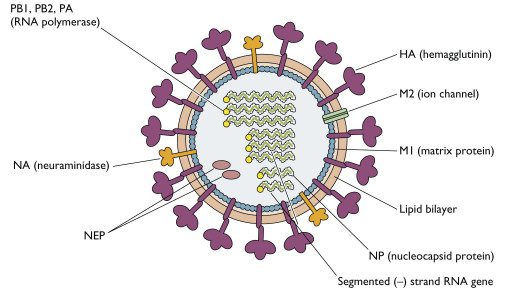
a) H1N1 flu is a new influenza virus causing illness in people. It has two genes from flu viruses that normally circulate in pigs in Europe and Asia, plus avian genes and human genes. Scientists call this a “quadruple reassortant” virus.
b) H1N1 flu is contagious. This new virus was first detected in people in the United States in April 2009. The virus is spreading from person-to-person, in the same way that regular seasonal influenza viruses spread.
c) H1N1 flu is NOT caused by eating pork or pork products. H1N1 flu is not a foodborne disease, it is a respiratory disease. All meat and poultry products have to be properly prepared and cooked before consuming them.
d) Illness with the new H1N1 flu virus has ranged from mild to severe. (While the vast majority of people who have contracted H1N1 flu have recovered without needing medical treatment, hospitalizations and deaths have occurred.)
e) About 70 percent of people who have been hospitalized with H1N1 flu have had one or more medical conditions that placed them in the “high risk” category for serious seasonal flu-related complications. These include pregnancy, diabetes, heart disease, asthma and kidney disease.
f) Unlike the seasonal flu virus, adults older than 64 do not yet appear to be at increased risk of H1N1 flu-related complications. CDC laboratory studies have shown that about one-third of adults older than 60 may have antibodies against this virus. It is unknown how much protection may be afforded against H1N1 flu by an existing antibody.
[Link: http://www.flu.gov/individualfamily/about/h1n1/index.html]
Why is 2009 H1N1 virus sometimes called “swine flu”?
This virus was originally referred to as “swine flu” because laboratory testing showed that many of the genes in this new virus were very similar to influenza viruses that normally occur in pigs (swine) in North America. But further study has shown that this new virus is very different from what normally circulates in North American pigs. It has two genes from flu viruses that normally circulate in pigs in Europe and Asia and bird (avian) genes and human genes. Scientists call this a "quadruple reassortant" virus.
[Link: http://www.cdc.gov/h1n1flu/qa.htm]
Sunday, 25 October 2009
Uses of Viruses

(Image: http://geneticsandsociety.org/img/original/science6.gif )
Viruses cause us much harm, however, their infectiouos ability have made them the prime candidate as vectors in gene therapy. Removing the harmful codes in their genome and using them to infect the target host cell and integrate the desired gene into the host genome is the idea.
They do run the risk of infecting the host despite removing the known disease causing part of the viral genome. Click here to learn more about them.
 Another use for viruses would be when they are dead and used as vaccines. This method has been in use for some time now. Click here to more about them.
(Image: www.accessexcellence.org/.../making_vaccines.php)
Apart from being used in the medical sector, viruses have also been introduced as biological pest controls. Read on to learn how they help to control insects which harm crops.
Apart from being used in the medical sector, viruses have also been introduced as biological pest controls. Read on to learn how they help to control insects which harm crops.
Video of Virus Entry
Video
This video shows the general viewer a simple overview of how a virus infects a host cell and replicates.
This video shows the general viewer a simple overview of how a virus infects a host cell and replicates.
Saturday, 24 October 2009
Virus Control
The virus is not controlled by antibodies that come in tablets. We can control viral infections of the body only with our immune system. Our white blood cells would combat with these foreign bodies when they are exposed to them. This concept is the basis of vaccines where dead viruses are injected into the body for the immune system to build up defence to it. Eventually, when the virus does infect the patient, he is able to counter the attack.
Viruses mutate at high rate, which impedes the body's immune system to control it. Different strains of a virus are increasingly found today. The flu virus itself has shown many faces, like H1N1 and H5N1.
Scientists have made breakthroughs in controlling virus growth. As mentioned about viruses having viral enzymes to fascilitate their replication and assembly, using enzyme inhibition could stop the virus. Since each step in the life cycle of a virus involves an enzyme, creating drugs that inhibit the enzyme prevents the growth of the virus. The challenges lie in early detection of the infection and the mutation rate of the virus. Using this concept, drugs have been made for the HIV.
Groups of Antiretroviral Drugs
There are five groups of antiretroviral drugs. Each of these groups attacks HIV in a different way.
1. Nucleoside/Nucleotide Reverse Transcriptase Inhibitors NRTIs -- NRTIs interfere with the action of an HIV protein called reverse transcriptase, which the virus needs to make new copies of itself.
2. Non-Nucleoside Reverse Transcriptase Inhibitors NNRTIs -- NNRTIs also stop HIV from replicating within cells by inhibiting the reverse transcriptase protein.
3. Protease Inhibitors PIs -- which is another protein involved in the HIV replication process.
4. Fusion or Entry Inhibitors -- prevent HIV from binding to or entering human immune cells.
5. Integrase Inhibitors -- interfere with the integrase enzyme, which HIV needs to insert its genetic material into human cells.
(Drugs information from: http://www.avert.org/treatment.htm)
Viruses mutate at high rate, which impedes the body's immune system to control it. Different strains of a virus are increasingly found today. The flu virus itself has shown many faces, like H1N1 and H5N1.
Scientists have made breakthroughs in controlling virus growth. As mentioned about viruses having viral enzymes to fascilitate their replication and assembly, using enzyme inhibition could stop the virus. Since each step in the life cycle of a virus involves an enzyme, creating drugs that inhibit the enzyme prevents the growth of the virus. The challenges lie in early detection of the infection and the mutation rate of the virus. Using this concept, drugs have been made for the HIV.
Groups of Antiretroviral Drugs
There are five groups of antiretroviral drugs. Each of these groups attacks HIV in a different way.
1. Nucleoside/Nucleotide Reverse Transcriptase Inhibitors NRTIs -- NRTIs interfere with the action of an HIV protein called reverse transcriptase, which the virus needs to make new copies of itself.
2. Non-Nucleoside Reverse Transcriptase Inhibitors NNRTIs -- NNRTIs also stop HIV from replicating within cells by inhibiting the reverse transcriptase protein.
3. Protease Inhibitors PIs -- which is another protein involved in the HIV replication process.
4. Fusion or Entry Inhibitors -- prevent HIV from binding to or entering human immune cells.
5. Integrase Inhibitors -- interfere with the integrase enzyme, which HIV needs to insert its genetic material into human cells.
(Drugs information from: http://www.avert.org/treatment.htm)
Subscribe to:
Posts (Atom)